
Every encounter reviewed
Every visit checked against your protocols and clinical guidelines. Notes, intakes, labs, scripts, follow-ups. Not a sample. All of it.
Full cohort Rubik MD
For medical directors, CMOs & clinic owners
Every visit checked against your protocols and clinical guidelines. Monday, a ranked queue: what needs your eyes, why, and the source line.
Built for clinics like yours
Average top-50 U.S. malpractice verdict in 2024. Up 75% from $32M in 2022 ($48M in 2023).
Of the largest publicly detailed 2025 mega verdicts left documentation-visible footprints: missed monitoring, dosing errors, follow-up failures.
Expert Institute · documentation-visible footprints in 20 of 23 cases
Mean paid malpractice claim (NPDB 2025, provisional). One paid claim already dwarfs a year of oversight software.
Accuracy on our proprietary GLP-1 chart benchmark. Charts stay in your environment.
Proprietary GLP-1 chart benchmark · see compare note below
The oversight gap
Chart review today is a thin random sample, weeks late. A top-50 verdict averages $56M. Most mega-verdict failure modes were already in the note: missing labs, thin documentation, contraindications, dosing, missed follow-ups. You’re accountable for all of it. States keep raising the floor.
Platform
Every visit checked against your protocols and clinical guidelines. Notes, intakes, labs, scripts, follow-ups. Not a sample. All of it.
Full cohortA ranked queue: which cases need manual review, why they flagged, and the exact snippet behind each.
For directorsEvery review logged. When a regulator, insurer, or attorney asks how you supervise, you show a record, not a policy binder.
Audit trailSame visit, a separate brief for in-house counsel: public dockets, warning letters, and enforcement patterns tied to the clinical flag. Not legal advice. Not for the medical director’s triage.
Counsel handoffHow it flags
Rubik MD doesn’t diagnose your patients. It points you where to look first, and every flag carries its reason and the source line behind it, so you confirm or dismiss with the source line in view.
Treatment started or continued without the workup your protocol requires.
Platform walkthrough
Caseload View
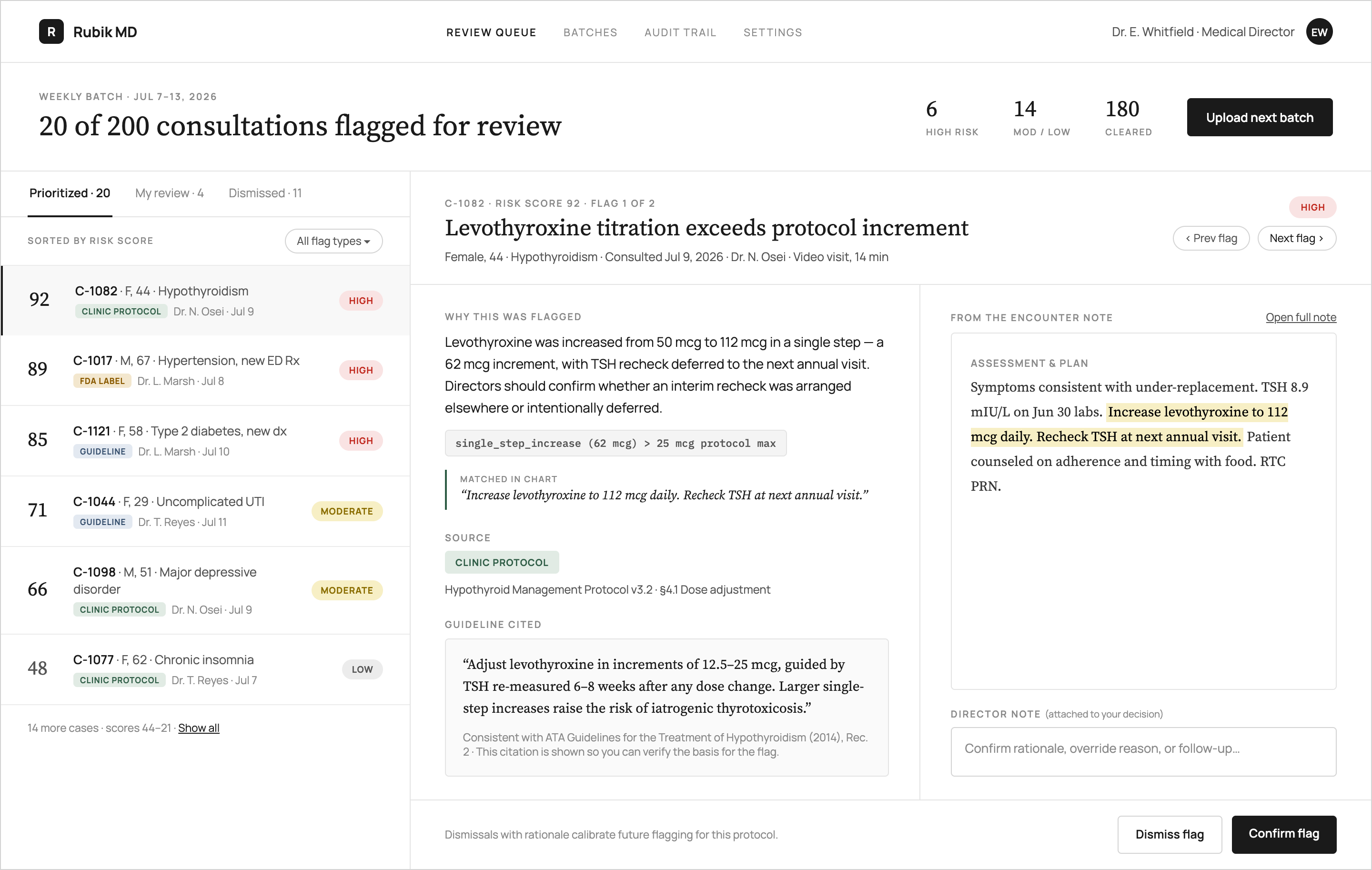
Your clinic exports visit data at week’s end. Processing runs fully private on your side. Monday the queue is waiting: every encounter reviewed, nothing changed in the clinician’s day.
| Practitioner | Cases | Status |
|---|---|---|
| Dr. Aris | 14 | Imbalanced |
| Dr. Chen | 3 | At limit |
| Dr. Patel | 6 | Balanced |
Same-week catch
GLP-1 started without a baseline metabolic panel. Protocol requires labs within 30 days.
Source: visit note, Jul 8 · See walkthrough evidence →
Without vs with
Medical directors already sign for every chart. The gap is what they can actually see: a thin random sample weeks later, or a full weekend review ready Monday morning.
| Dimension | Without Rubik MD | With Rubik MD |
|---|---|---|
| Chart coverage | Random sample of roughly 1–5% of visits. Most charts are never touched. | Every encounter screened. You get a ranked queue of what needs a second look. |
| Timing | Manual review weeks or months after the visit, after the trail has cooled. | One export at week’s end. Weekend processing. Queue waiting Monday morning. |
| What you see | Whatever happened to get sampled. No view of what slipped through the rest. | Missed labs, dosing gaps, follow-ups, thin notes. Each with the source line. |
| Why a chart was reviewed | Usually no record of why a chart was pulled, or why it wasn’t. | Every flag cites protocol, label, or guideline. Confirm or dismiss is logged. |
| What you can show | A protocol binder or an attendance credit when someone asks how you supervise. | An oversight log: volume reviewed, flags raised, decisions recorded. |
| Clinician workflow | True 100% human review doesn’t scale, so it doesn’t happen. | Zero change to the treating clinician’s day. Oversight runs on the export. |
| Your judgment | Still liable for care you largely can’t see. Sampling feels fine until it isn’t. | You still decide. Rubik MD points where to look first. It doesn’t replace you. |
Not a medical device and not a diagnosis. Dollar figures are published malpractice benchmarks, not a claim that Rubik MD prevents litigation. The 99% figure is measured on our proprietary GLP-1 chart benchmark.
Team
Nazmi has lived the medical-director gap inside a telemedicine company. Berend builds the detector and the benchmarks that score it.
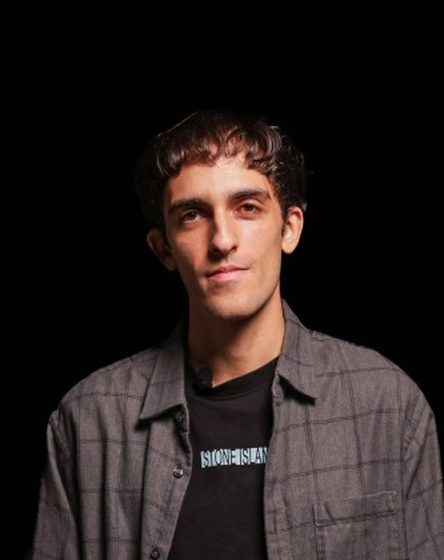
CEO & Co-founder
Runs the clinic side. Founded a Plug and Play-backed telemedicine company. He has watched medical directors sign charts they never read. Rubik MD gives them the Monday queue they were missing.
LinkedIn →
CTO & Co-founder
Builds the detector, the BoardQA benchmark, and the scoring pipeline. Research engineer focused on production LLM infrastructure and measurement that stays honest on synthetic chart cohorts.
LinkedIn →FAQ
What Rubik MD does, how we start, and the hard questions medical directors and operators ask first.
Clinical oversight doesn’t scale with consultation volume. The industry standard is a manual, random review of around 5% of charts, often weeks or months later. Everything else goes unreviewed.
Rubik MD helps review 100% of charts, surfaces the cases that need human attention most, and shows why. Clinical expertise lands where it matters, and the people responsible for oversight get full visibility for the first time.
Named, verifiable sources. Not an AI black box; every check has a source:
No. Rubik MD is read-only and assistive by design. It never touches the patient, the chart, or the live workflow; it never diagnoses, prescribes, or recommends treatment. It surfaces cases and evidence. Your clinicians own every judgment.
One periodic export of visit data (notes, labs, prescriptions). Not a live EHR project, no workflow change for treating clinicians, and we stay read-only. On many cloud ambulatory systems a practice admin can produce that export themselves. On Epic, the path depends on whether the clinic owns the instance or sits on Community Connect; we still start with a small chart package and never write back into the chart.
One location, one export, a small batch of charts. We show you what surfaces from an ordinary week of ordinary practice. That alone tells you everything. From there, the same export on a regular cadence, across as many locations as you want visibility into.
Days, not months. The first batch of results arrives within a week of the first export.
Different user, different moment, different job:
The two are complements. The more copilots produce richer documentation, the more there is to oversee.
No. CDSS is a live guardrail on the ordering screen. It fires at the prescribing clinician on one order in isolation, which is why alerts get dismissed mid-visit.
Rubik MD reviews the full chart asynchronously, across days or months and across the organization’s charts, for deviations that only show at that depth. Flags go to the people accountable for oversight (site medical director, CMO), not the busy daily prescriber, and every flag carries its source.
On our proprietary GLP-1 chart benchmark, Rubik MD reaches 99% accuracy. Clinical validation happens with design-partner data, on real charts, reviewed by the client’s own clinical leadership. That’s what the pilot is for, and why the first batch tells you everything.
No. Your data is used only to run your review. The system does improve at your specifics: each confirmed or overridden flag tunes it to your protocols, and that tuning belongs to your deployment.
We raise the floor; we don’t promise a ceiling. Today, the miss rate on the 95% of charts nobody reviews is 100%. Rubik MD screens everything, prioritizes what carries risk, and documents human review of those cases. No process, human or machine, guarantees detection. What we guarantee is systematic coverage, sourced reasoning, and a recorded resolution for everything surfaced.
This is visibility into what’s happening. It is not policing.
The exposure already exists; today it’s just invisible. A documented process where risks are surfaced, reviewed, and resolved is the defensible position, and it’s the evidence carriers credit and regulators ask for. What’s dangerous is a known risk that’s ignored. What’s indefensible is having no process at all.
Know what went out last week before Monday morning.